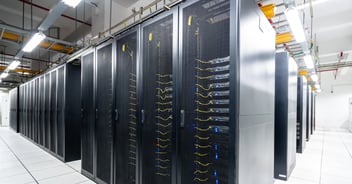
AI inference has become the operational center of enterprise AI, where latency, compliance, cost, and user experience converge. As inference workloads move closer to users and sensitive data, organizations are building distributed inference fabrics spanning cloud, colocation, and edge environments. Colocation data centers play a critical role by delivering predictable performance, data sovereignty, and scalable power density for production AI.
 Inference is the process where trained AI models generate outputs from real‑world inputs and it is quickly becoming the center of gravity for enterprise AI. As organizations rush to operationalize AI, inference is where performance, compliance, cost, and user experience converge. It is also why organizations are suddenly scrutinizing everything from data center design to network topology: the infrastructure behind inference now determines whether AI actually works at scale.
Inference is where enterprise AI becomes real and where data center and network decisions determine if AI runs fast, meets organizational needs, and remains compliant and cost‑effective. While frontier‑scale training is still dominated by hyperscalers and specialized providers, most organizations own and manage the serving layer: the inference infrastructure that delivers model outputs into products, workflows, and critical operations.
As AI moves from pilots to production, that serving layer—data centers, networks, and supporting systems—must be architected for latency and cost, as well as data sovereignty and sector‑specific regulatory requirements.
From training headlines to inference constraints
The initial wave of AI investment focused on model size, GPU scarcity, and large training runs. In many organizations, strategy discussions centered on whether to fund dedicated training capacity or rely entirely on external platforms. That operational reality looks different today.
Models today are more often sourced than built. Foundation and domain models arrive via cloud APIs, commercial vendors, and open‑source ecosystems, with fine‑tuning applied only when distinct behavior is needed. The ongoing workload is inference: every chatbot exchange, video object detection, Copilot action, recommendation, fraud score, and real‑time alert runs through production inference services.
Training and inference are structurally different. Training is centralized, batch‑oriented, and episodic. Inference is continuous, user‑driven, and geographically distributed, touching live and often sensitive data. As AI becomes more embedded in customer‑facing and mission‑critical processes, inference replaces training as the binding constraint on performance, cost, and regulatory exposure.
Why location of inference matters
Questions about where computing happens are not new in regulated industries, but AI inference makes the link between data rules and infrastructure choices much tighter. When models handle government citizen data, financial information, health records, or critical operational data, the location and conditions under which that processing occurs become essential from both a legal and operational standpoint. Key considerations include:
- Which jurisdictions’ laws apply when data is processed, even transiently
- How logs, prompts, outputs, and telemetry are stored, replicated, and accessed
- What obligations exist around discovery, retention, and supervisory controls
A cloud‑only, globally distributed inference setup can unintentionally send live data into other countries or legal environments, creating compliance challenges and added risk. In some industries, regulators now expect certain types of sensitive processing to stay within the country ….. and in some cases, inside specific certified facilities. Because AI inference uses raw customer and operational data in real time rather than delayed, pre‑processed reports, the location of that computation becomes a significant compliance decision, not a minor technicality.
Latency and proximity reinforce the need for local processing. Tasks such as retrieval‑augmented generation on localized data, real‑time fraud or risk checks on domestic transactions, and AI control systems in factories or stores work best when the network path between users, systems, and AI endpoints is short and predictable. When all inference is concentrated in a few distant regions, it can lead to lag, unstable performance, higher data‑transfer costs, and unclear jurisdictional boundaries.
The emerging pattern: an inference fabric across cloud, colocation, and edge
In response, architectures are shifting toward a distributed inference fabric that spans public cloud, metro-area colocation, and on‑premises or edge colocation deployments.
Public cloud remains central for training, model evaluation, and early‑stage inference. It provides access to cutting‑edge accelerators and managed services. It is also well suited to experimentation and unpredictable workloads, especially when those workloads can be confined to specific regions and supported by well‑controlled data pipelines.
Metro colocation facilities are increasingly hosting regional inference clusters. These sites are selected in key metros where major user populations, enterprise data centers, and cloud regions intersect. They provide:
- Power and cooling capable of supporting heterogeneous hardware
- Direct connectivity to availability zones, cloud regions, carriers, and internet exchanges
- Private links back to campuses, plants, logistics hubs, and branch networks
Edge and on‑premises deployments embed inference directly into the operational environment: manufacturing plants, hospitals, retail locations, logistics hubs, grid assets, and field sites. On‑device models and local servers handle ultra‑low‑latency tasks and maintain behavior when wide‑area connectivity is impaired, while metro and cloud tiers handle heavier reasoning and coordination.
A control plane (human, computer-driven, or otherwise) coordinates placement and routing based on defined policies. Certain classes of data and workloads may be pinned to certain facilities only, or even to specific states or sites, while other workloads are free to use global capacity. Latency requirements and business criticality are considered alongside potential sovereignty requirements when deciding whether a particular inference should execute on device, in a nearby metro colocation data center, or in cloud.
The limits of public cloud for inference
Public cloud remains indispensable for inference, but its role is more clearly bounded. Yes, cloud platforms are key for large‑scale training and evaluating new models and architectures. They also serve as an effective “burst” tier for inference to absorb overflow when demand in metro data center clusters exceeds capacity or incidents take local resources offline.
But relying solely on cloud regions for inference introduces structural risks. Capacity and pricing can shift, reducing cost predictability and availability. Rising demand will push GPU economics toward the usual cloud cost patterns. But if latency is a priority, cost advantages will likely come from housing infrastructure in colocation data centers or on-prem, rather than in cloud regions.
In addition, egress and inter‑region fees accumulate as data moves among on‑prem, colocation, and cloud services. Multi‑tenant designs can also limit granular control over where inferences and logs are processed, complicating sovereignty and compliance.
By placing steady, high‑volume inference on dedicated metro‑based infrastructure in colocation data centers or on-prem, and reserving cloud for training, experimentation, and overflow, organizations can lower long‑run unit costs and gain more predictable latency and regulatory postures.
Evaluating colocation data center services with an inference lens
Viewed through this lens, colocation data center and network services are no longer a neutral element. Their geography, connectivity, and operational model actively shape what AI an organization can deploy and where.
Colocation providers are prime hosts for regional inference clusters that serve as hubs for AI‑enabled services across multiple states or cities. The richness of cloud, carrier and internet exchange connectivity at those sites determines how easily and efficiently those clusters can integrate with systems and serve local users. High-density power and cooling capabilities at these colocation data centers also define how quickly the hardware mix can evolve from CPU‑heavy to GPU‑ and accelerator‑rich footprints.
Equally important are alignment with governance requirements. Colocation providers that can clearly document where data is processed and stored, support necessary certifications, and integrate with enterprise monitoring and change management make it easier to demonstrate control to internal risk stakeholders and external regulators.
A structural shift in what it means to be AI‑ready
Enterprise AI has reached a stage where inference, not training, should be the primary driver of infrastructure design, especially under regulatory constraints. The infrastructure that organizations, customers, and regulators interact with daily is the distributed inference layer spanning cloud, colocation, and edge environments. In this context, being AI‑ready means more than simply having GPUs available. It requires an inference fabric that:
- Delivers the latency and availability expected of critical services
- Meets national, state, and sector‑specific sovereignty requirements
- Scales economically as adoption grows
Colocation data center and network choices directly determine whether such a fabric can be built and sustained. Organizations that prioritize inference locality and sovereignty are better positioned to deploy AI that is fast, compliant, and deeply integrated versus a fragile layer dependent on distant regions.
Why Csquare colocation data centers for inference workloads
Csquare colocation data centers align naturally with the emerging inference fabric because our facilities are engineered for the power density, cooling, and connectivity that modern AI workloads demand. Many inference clusters now require 30 –100kW or more per rack. Our data centers are designed to support these high‑density AI and xPU footprints with advanced cooling options, including in‑row cooling, rear‑door heat exchangers, and liquid‑cooling configurations that scale up to 125kW per rack. This combination makes Csquare a strong fit for sustained, production‑grade inference workloads that need predictable performance and room to grow as models, and accelerators evolve.
Csquare also offers advantages in network proximity and operational assurance that are essential for inference. With 80 strategically located data centers across primary and secondary North American metros, as well as carrier‑dense markets, Csquare enables inference clusters to operate close to users, enterprise campuses, branch networks, and major cloud regions. This proximity reduces latency and improves availability for real‑time AI services.
In addition, our facilities provide carrier‑neutral connectivity to more than 200 network and cloud providers and are backed by a 100% uptime guarantee. As a result, inference workloads remain fast, resilient, and compliant as AI becomes embedded in customer‑facing and mission‑critical operations. For enterprises prioritizing locality, sovereignty, and cost‑efficient scaling of inference, Csquare delivers the power, network reach, and operational discipline needed to support AI at production scale. Learn more at csquare.com.